3,800 METERS
APRIL 15TH
A descent to the Titanic
April 15, 1912 — April 15, 2026
↓
Scroll to descend
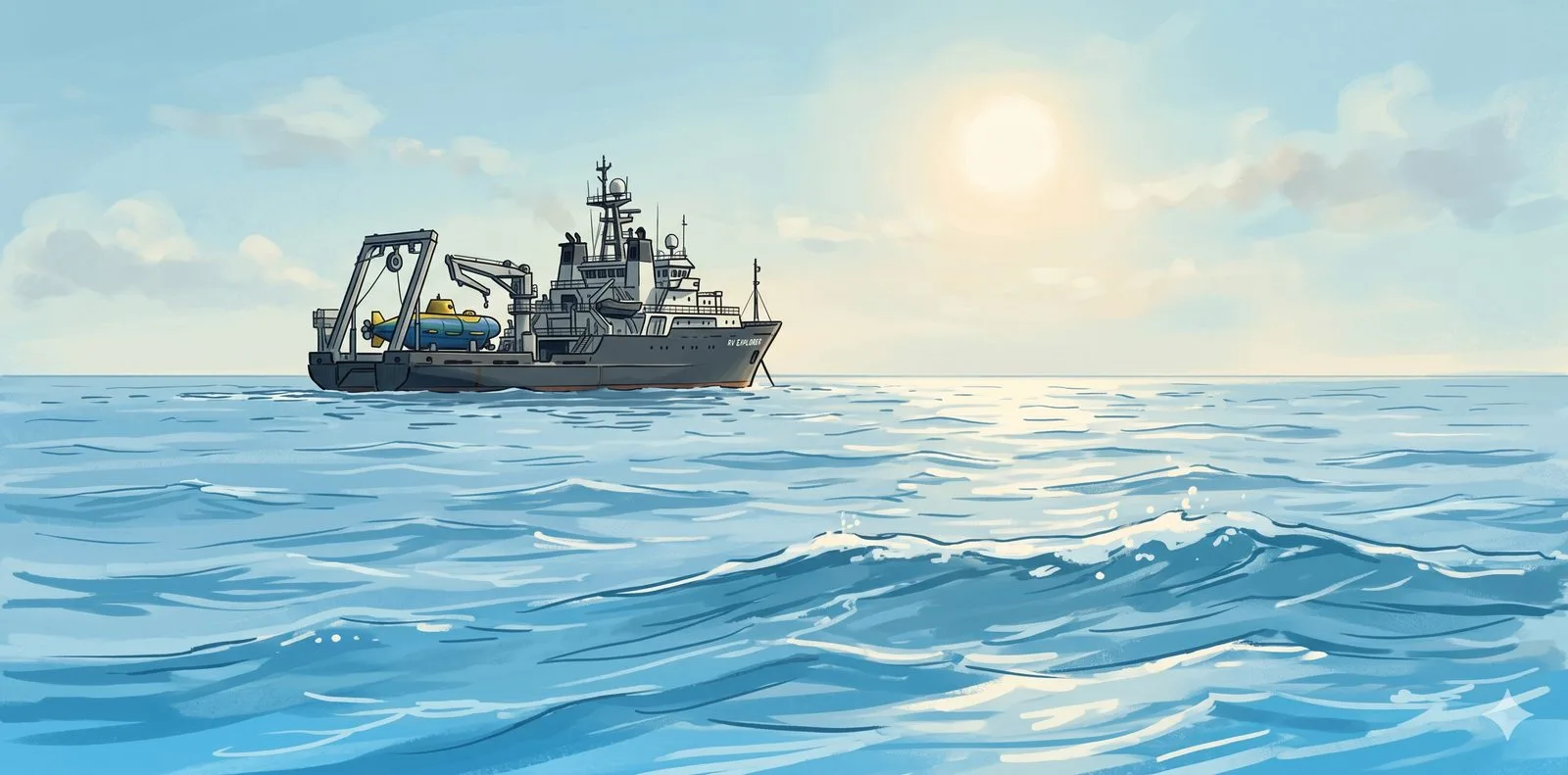
3,800 METERS
A descent to the Titanic
April 15, 1912 — April 15, 2026
10m
The depth of an Olympic diving pool. Pressure has already doubled from the surface. Light everywhere. You can still see your shadow on the sand.
40m
Below here, nitrogen narcosis — the rapture of the deep — makes divers euphoric, then unconscious. Cousteau called it l'ivresse des grandes profondeurs.
93m
If Lady Liberty stood on the ocean floor here, her torch would just break the surface. 93 meters of copper and ambition, and the ocean barely notices.
150m
Colors vanish in order as depth increases: red first, then orange, yellow, green. Eventually only blue remains. Then that goes too.
200m — ZONE BOUNDARY
Photosynthesis is impossible below this line. 71% of Earth's surface is ocean. You've just left the part we understand.
Below here, 76% of all animals make their own light.
260m
RMS Titanic was 269 meters long and weighed 46,328 tons — the largest moving object ever built by human hands when she launched in 1911. She had a swimming pool, a Turkish bath, a squash court, and a Parisian café. She carried 10,000 lightbulbs. She was designed not just to cross the Atlantic, but to make you forget that you were.
332m
The Eiffel Tower, inverted, would reach this deep. And here, in 2014, Ahmed Gabr set the deepest scuba dive record. Fifteen minutes down. Thirteen hours and thirty-five minutes back up.
443m
102 floors of Art Deco ambition, antenna to lobby, fully inverted. And it still wouldn't reach the bottom of the Twilight Zone.
500m
Architeuthis dux. Up to 43 feet of tentacle and centuries of myth. Nobody photographed one alive until 2004. Most military submarines would be crushed at this depth. The ocean doesn't care what we build.
640m
The Titanic carried 20 lifeboats — enough for 1,178 people. There were 2,224 aboard. This was not a violation: British regulations required lifeboats based on ship tonnage, not passenger count, and Titanic met them. The regulations changed after April 15, 1912.
Lifeboat No. 1, with a capacity of 40, left with 12 people aboard — including Sir Cosmo Duff Gordon and his wife. They rowed away from the sinking ship and did not go back.
828m
The tallest structure humanity has ever built, fully submerged to its spire. 828 meters of glass and steel. Below it: only darkness.
900m
Captain Edward John Smith had been at sea for 40 years. He was 62 years old. This was to be his final voyage — he planned to retire after arriving in New York. He did not survive. His last known words were reported differently by different witnesses. His body was never recovered.
1,000m — ZONE BOUNDARY
No photon of sunlight has reached this water in the history of the planet. Total darkness. 101 atmospheres of pressure. Every light from here on was made by something alive.
1,200m
They hover here, dangling bioluminescent lures in the permanent dark. The males are tiny — they bite onto a female and fuse permanently into her body, becoming nothing but a pair of gonads. Romance at 1,200 meters.
1,500m
Her wreck rests at this depth off the Irish coast. Sunk by a torpedo in 18 minutes. The Titanic took 2 hours and 40 minutes. The speed of sinking is what determines who gets a lifeboat.
1,857m
The deepest point of the Grand Canyon — six million years of the Colorado River's patient work — would be fully submerged here. This water has been here longer.
2,000m
Armored scavengers the size of footballs. They can survive five years without eating. When they finally feed, they eat until they can barely move. Deep-sea patience.
2,200m
Of the 2,224 people aboard, 710 survived — a survival rate of 32%. But the numbers fracture along class lines: 62% of first-class passengers survived. 41% of second-class. 25% of third-class, many of whom were kept below decks as the lifeboats filled above them.
2,500m
They pulse through the darkness, ear-like fins flapping in slow motion. Unlike their shallow-water cousins, they swallow prey whole. Some have been found as deep as 7,000 meters.
2,700m
Nothing lives here. The ocean has been patient for four billion years. It can wait.
2,992m
In 2014, a Cuvier's beaked whale dove to this exact depth — the deepest dive ever recorded by a mammal. It held its breath for three hours and forty-two minutes. Then it swam back to the surface.
3,200m
This water is 1°C. It last touched sunlight near the Arctic, possibly centuries ago — carried here by deep ocean currents that take a thousand years to complete one loop. This water is older than your country.
3,300m
On April 14, 1912, Titanic received at least six separate ice warnings from other ships. Most were not passed to the bridge. At 9:40 PM, the steamship Mesaba sent a direct warning describing heavy pack ice and icebergs in the exact region ahead. The radio operator set it aside. At 23 knots, in the dark, the ship sailed on.
3,400m
April 14, 1912. Lookout Frederick Fleet spots a dark mass ahead and rings the bell three times. He telephones the bridge: Iceberg, right ahead. First Officer Murdoch orders hard a-starboard. Thirty-seven seconds. Not enough.
3,500m
Eight musicians led by violinist Wallace Hartley played for over two hours as the ship went down. They were not required to. They were not asked to stay. All eight died. Hartley's violin, a gift from his fiancée, was recovered from the Atlantic. In 2013, it sold at auction for £1.1 million.
3,600m
The stern rose until it was nearly vertical — every light still blazing. Then the ship split in two. 1,517 people were in the water. The temperature was -2°C. The nearest rescue ship was 58 miles away.
3,750m
The bow section fell for six minutes, reaching 30 miles per hour. When it struck the seafloor, it buried itself 60 feet into the sediment — a six-story building's depth of impact.
3,800m — 12,467 ft
41°43′57″N · 49°56′49″W
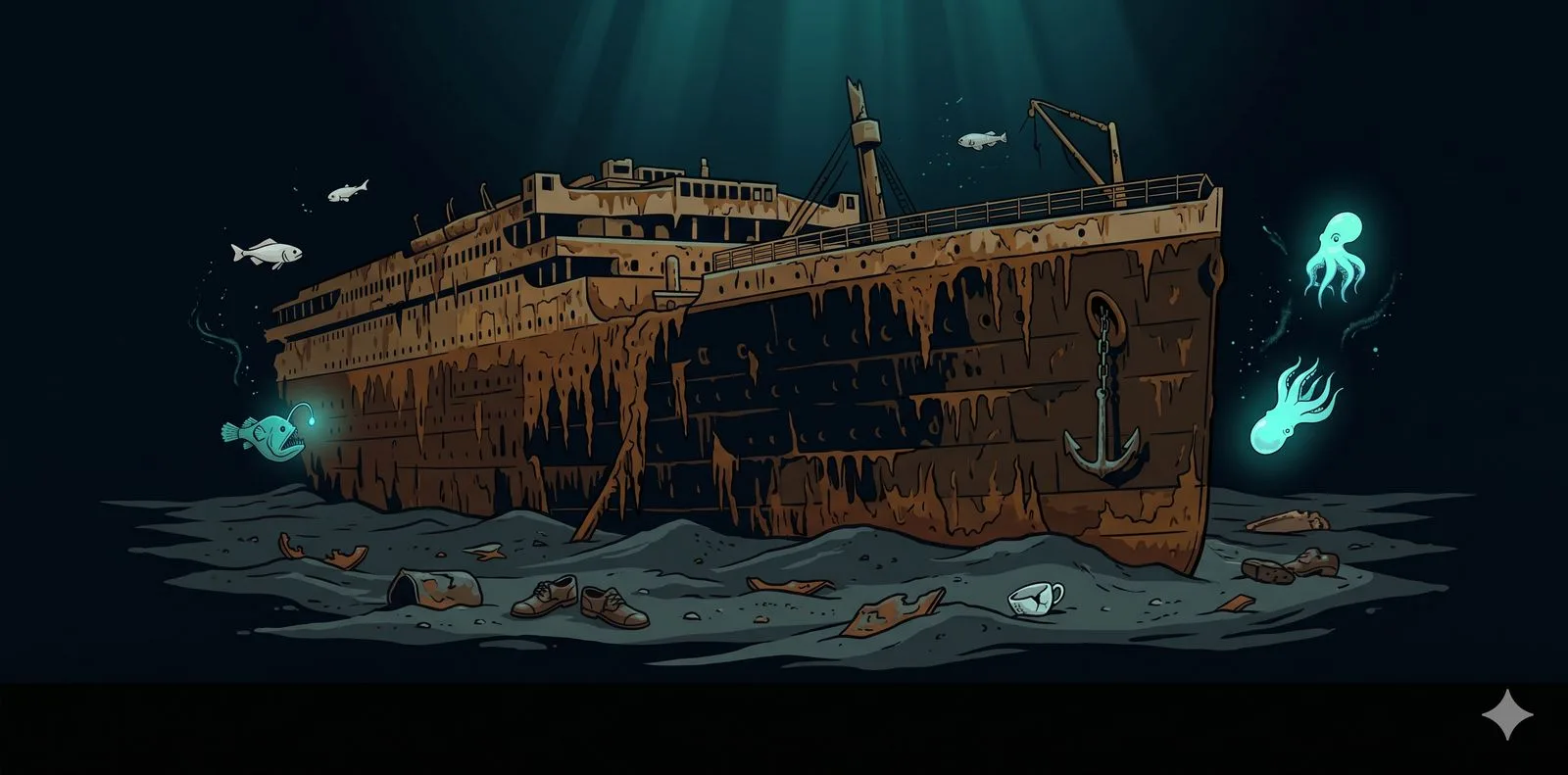
She has been here since the early hours of April 15, 1912 — exactly 114 years ago today.
Not found until 1985, when Robert Ballard spotted one of her boilers on a camera sled at 1:05 AM. His expedition was secretly funded by the U.S. Navy to survey two lost nuclear submarines. Ballard had twelve days left over to search for the Titanic.
Bacteria called Halomonas titanicae are consuming her hull at 400 pounds per day, forming icicle-like structures called rusticles. By 2050, there may be nothing recognizable left to visit.
The shoes remain. Scattered across the debris field, preserved by the tannin in the leather. They rest in pairs — marking where someone came to rest on the ocean floor. The cold and the creatures took everything else long ago. But the shoes remain.
The RMS Carpathia arrived at 4:10 AM and rescued 710 survivors from the lifeboats. The water was −2°C. She searched for two more hours, finding no one else alive. Then she turned for New York.
↑ RETURN TO SURFACEThe story of the Titanic has become woven into popular culture — films, books, exhibitions, songs, and pages like this one. What began as an act of industrial pride became one of history's defining disasters, and its mythology has only grown in the century since.
Behind every fact here are real people. 1,517 of them did not survive. Thousands more — families, survivors, rescue crews — carried the weight of that night for the rest of their lives. Their loss reshaped maritime law, changed how we think about class and safety, and left a wound that still hasn't fully healed. This page was built with curiosity and craft, and with genuine respect for what actually happened here.
Created with Beaver Builder